A thousand keyword ideas sounds like a week of work. With the right free methods it is about ten minutes, because you are not inventing keywords, you are collecting them.
Every method below mines something that already exists: autocomplete, question patterns, modifiers, competitor menus. Stack all six and a handful of seeds becomes a thousand real phrases.
| Minute | Method | Free tool | Ideas it adds |
|---|---|---|---|
| 0 to 3 | Autocomplete expansion | The generator on this site | 400 to 700 |
| 3 to 4 | Question keywords | Question tools | 100 to 200 |
| 4 to 6 | The modifier matrix | A spreadsheet | 150 to 300 |
| 6 to 8 | Competitor menus | Their websites | 30 to 80 |
| 8 to 9 | One AI brainstorm | ChatGPT | 30 to 60 |
| 9 to 10 | Related searches | Google's results page | 30 to 60 |
Why a handful of seeds becomes a thousand ideas
The math does the work for you. One seed keyword branches into every letter, every question word and every modifier people type after it.
Minutes 0 to 3: Run your seeds through autocomplete
Start with 5 seed keywords, the short phrases your whole topic hangs off. For a home fitness site: home workout, dumbbells, resistance bands, protein, stretching.
Feed them to the keyword generator on this site. It mines Google's autocomplete for every phrasing people actually type and streams the results live.
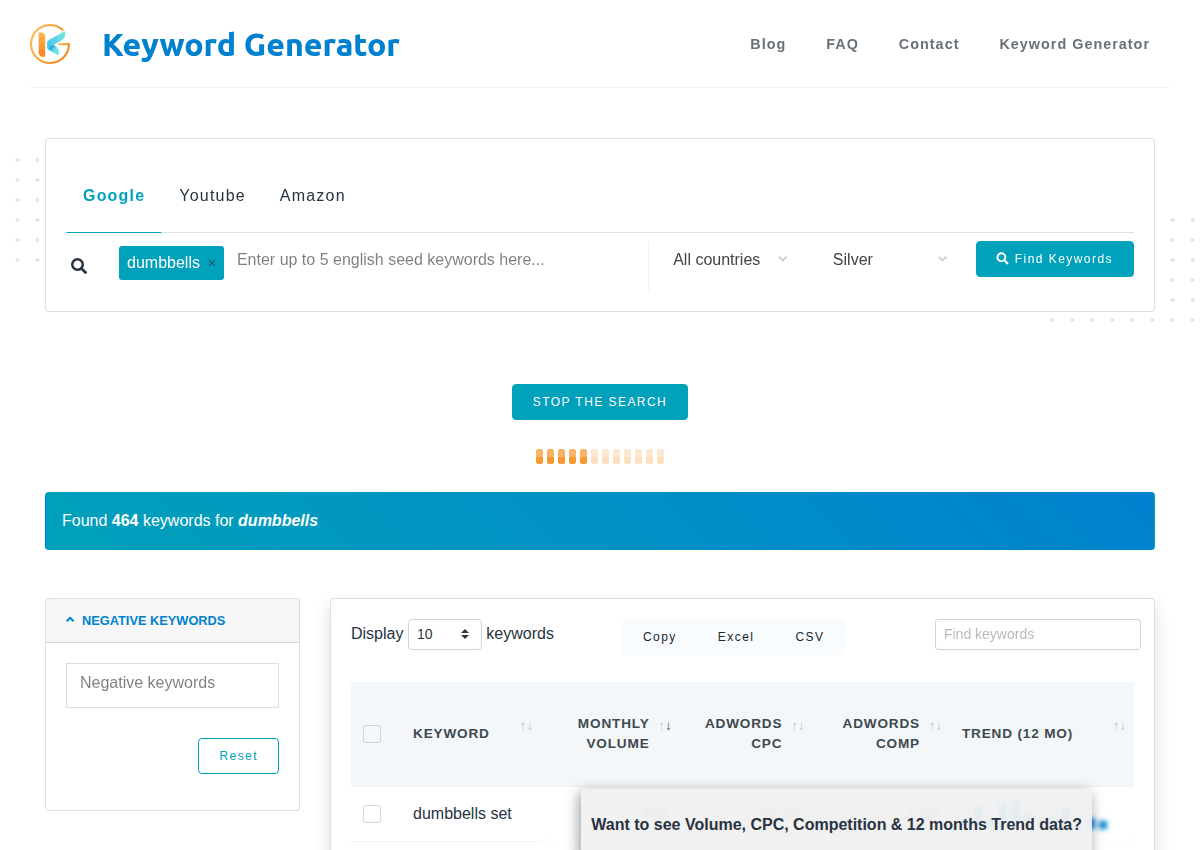
A Silver search is the fast pass, and a Gold search digs roughly 10x deeper if you have the extra minutes. Either way you export a few hundred real phrases before your coffee cools.
Minute 3 to 4: Add the question keywords
Questions are where informational content lives, and they follow patterns: how, what, why, can, does, is, versus. Question tools like AnswerThePublic cross your seeds with each pattern automatically.
"Can you build muscle with resistance bands" is a real search you would never think of at a blank spreadsheet. The patterns think of it for you.
Minutes 4 to 6: Build the modifier matrix
This one needs no tool at all, just a spreadsheet. Put your seeds down the side and the standard modifiers across the top.
The modifier set that covers most niches: best, cheap, free, top, vs, alternative, for beginners, for [audience], with [thing], without [thing], near me, review, ideas, examples, template.
Not every cell will be a real search, and that is fine. You are generating candidates, and the validation step later removes the duds.
Minutes 6 to 8: Raid competitor menus and sitemaps
Open three competitor sites. Their navigation, categories and blog titles are keyword research they already paid for.
Add /sitemap.xml to their domain and you often get every page title on the site in one screen. Copy anything relevant into your list.
Minute 8 to 9: One AI brainstorm, with a rule
Ask ChatGPT one thing: "List 30 subtopics of [your niche] that beginners ask about". Take the themes.
The rule: ignore any search volumes it claims, because language models invent numbers. Themes in, numbers never.
Minute 9 to 10: Sweep the results page itself
Search your main seed on Google and scroll. People Also Ask, related searches at the bottom, and the bolded words in snippets are all free keyword ideas.
The related searches for a seed are especially useful because Google is telling you what it considers adjacent. That is topical mapping for free.
You have 1,000 ideas. Now what?
Dedupe the list in your spreadsheet, then shortlist what fits your site. Only then add data: run the shortlist through Google Keyword Planner for volume, CPC and competition.
Generation is cheap and validation is where judgment lives. Keeping the two steps separate is what makes both fast.
The one-line takeaway: keyword ideas are collected, not invented. Autocomplete, questions, modifiers and competitor menus hand you a thousand real phrases in ten minutes, free.